Entries sorted by date:
25-Nov-2010
16-Nov-2010
09-Nov-2010
05-Nov-2010
31-Oct-2010
26-Oct-2010
24-Oct-2010
22-Oct-2010
19-Oct-2010
16-Oct-2010
15-Oct-2010
13-Oct-2010
16-Aug-2010
13-Aug-2010
11-Aug-2010
04-Aug-2010
02-Aug-2010
30-Jul-2010
26-Jul-2010
24-Jul-2010
05-Jul-2010
26-Jun-2010
25-Jun-2010
22-Jun-2010
05-Jun-2010
01-Jun-2010

 25-Nov-2010:
A Sad State of Affairs
25-Nov-2010:
A Sad State of Affairs
I am proud and pleased to say that HAX Facebook is the definitive website for information on cyberpunk and dark future cinema. I am less pleased to say that after comparing it with almost everything else. Machete Girl focuses on their fanzine so they are forgiven but most of the other cyberpunk genre sites are either dead or it's been years since the last update. If I can use the cyberpunk film mini-reviews and trailer links to pull visitors to HAX Facebook I will but it is not what I first intended.
So, if you are into dark future/street scifi/cyberpunk, check it out and spread the word. You'll get the benefit of having a one-stop site for whats hot in the genre regarding audiovisual entertainment and we'll have the benefit of your company, increased visitor numbers and opportunities to push the HAX marketing message (yes, that geeky dev blog -type of thing) on you. I have still a few more works in my library to go through but I am also actively looking for new stuff to review. The selection criteria is simple: does it match the commonly accepted perceptions of cyberpunk and/or does it contain elements that relevant or have been inspirational when designing HAX?
The quality bar is set low but not so low that utter turds like Narcosys or Cyberjack would be on the list. There are some amazingly bad attempts at cyberpunk out there. I guess it is same in any genre but the crap-to-gold ratio in dark future cinema seems even worse than in most other genres. I am basically buying up everything I think might be relevant but yeah, it seems like I find 5 turds for every pearl (like Cyber Wars).
This might be the last blog entry for about a week again. I have a busy weekend ahead of me and the first KAJAK e-lecture on level design is coming up on Tuesday morning. 24 hours of lectures does not sound all that bad but before you sign up for this job, remember that will spend another 48 hours preparing the materials and powerpoint presentations. When you are looking at 72 hours the pay is suddenly not so hot anymore but I really want to do this stuff. It teaches me as much as it hopefully teaches the students. I've been doing level design for years and years but have I ever really stopped to think why I did things one way and not the other? Now I have to give a reason for them and if I can't, there is a good chance I've been doing something wrong.
In that sense I am just one of the students.
16-Nov-2010:
Drawing Plans
In breaking news: S.T.A.L.K.E.R. TV Series!
I don't even care if this will be shit. I am SO getting this as soon as it comes out.
I have also learned that there are something like 40 novels based on S.T.A.L.K.E.R. out in Russian. A few of them have been translated into German but for the most part the West is completely oblivious about this. Great news for the most part but it throws a wrench into my musings about writing something based on my Stalker RPG. Whether I intended it or not, that's where the two franchises would become rivals. Right now I benefit from the increased visibility GSC has given to the Stalker Mythos. I prefer it that way and to underscore the point, Fantasiapelit has again ordered a box of Praedor and Stalker each, along with a small handful of Taiga. The product is not dead yet.
Speaking of Stalker RPG, I now have another translator candidate. I know we've been here before and it did not work out but I wont stop trying. I am not going to do it since I am up to my neck in Wirepunk right now but I will be looking for a way to get it translated until someone higher up in the licensing chain tells me to stop. There has occasionally been buzz about Stalker RPG in the non-Finnish RPG circles. If and when the bloody thing finally comes out in English, I expect the original buzzers to play their part in getting it out there ;)
While waiting to hear back from my editor, I've been drawing up plans for my next literary venture: a cyberpulp novel, based on HAX and starring the lovely Kanyah Belaya, AKA Arkangel. Actually, Kanyah and Arkangel are two separate entities with increasingly differing personalities, even though their memories and experiences are synchronized every once in a while. Kanyah always was a human while Arkangel started out as a neuralnet copy of her consciousness. She has since then become more a projection than a copy, shaped by Kanyah's feelings, fears and desires rather than the actual synchronization of information and experiences. And while Kanyah lives in fear, hiding from authorities, bounty hunters and gangs, Arkangel is almost god-like in her bizarre realm, the Link. Whenever Kanyah is ghost running, she gets a taste of that power. Returning to meatspace... well, it is a bitter pill to swallow.
While I am toying with things like transhumanism, AI psyche and an entire future of networked societies, I also want to write pulp. That means writing for entertainment and appealing to the more base emotions and desires of the readership, much like when designing a game. Violence abounds and sex should too, although I am too modern (or repressed) to match Howard's raw fantasies. Overall, people are driven by their emotions rather than reason and stereotypes or cliches are to be embraced rather than avoided. Plotlines are straightforward and short but you'll have to dig through layers of exploitation to get there.
They used to sell pulp stories at newspaper kiosks before it was legal to sell porn. Just imagine if I could draw even a fraction of that crown back into science fiction? I don't think that's going to happen but in my mind I am already competing with Korkeajännitys for shelf space.
09-Nov-2010:
Häirikkötehdas Review
I still haven't heard from the Häirikkötehdas editor but the CEO of Finnlectura has been reading my script. Let's just say the first reactions have been more positive than I dared to hope for. I know it is not a real book review and I have a feeling real reviewers might see it a bit differently. But at least he seems to have been carried away by it and if I can make that happen to a handful of more people, the book has succeeded in its goal of... hell if I know. I saw it as a kind of a contemplative autobiography with a strong focus on my school years as a pupil and later as a teacher. He sees is it as a provocative pamphlet and a manifesto for the geek subculture in the context of schools and teaching. As of yet I have no idea what a more neutral reader would think but let's wait and see if the editor has any comments on that.
Just because I had a very vague idea of what kind of a book I was writing does not mean I gave up on my literary principles. Apart from product specifications, I write to entertain even when I am writing what I consider to be hard fact, or I am reminiscing something that really happened. I try to be evocative and make even the dullest and most mundane things seem interesting through a choice of words and approach. This seems to have worked, as far as the publisher's CEO was concerned. Häirikkötehdas is aimed to come out at Educa Fair at the end of January. It is in Messukeskus and I'll probably go there as well to speak about the book, answer some questions and dodge tomatoes thrown by angry elementary school teachers.
I'd better savour this moment. Even if the book gets crushed by critics or is politely given the silent treatment by those I actually know, I can still look back to this moment and remember how someone, somewhere was impressed. I have ten short and stubby fingers. My short and stubby fingers still got it. Self-esteem is good, especially if I am planning to do fiction next. After all, fiction is "just lies some dude got paid for", as one of the seniors at Recoil Games so eloquently put it. I have to be a good enough liar to pull it off. Starting slowly, like presenting childhood memories in a colourful and evocative manner, is a good start.
While the novel is doing well, our bid to get HAX funding from the Nordic Game Fund is dead in the water. If we had got we would have heard of them by now (on last Thursday, actually). No phone call, no money. This is not a surprise as such. They've received over 200 applications and have enough money for around 10. They also tend to invest in projects that have a solid backing from other investors or the developer is otherwise stable and has convincing portfolio. Wirepunk neither has other investors nor anything at all in its portfolio. Our CVs make a pretty impressive read but that's about it. Still, whenever you send out those applications you have this false hope that it might lead to something. After all, if you don't believe in your own idea, why should the players?
Part of the application is a 6-page description of the game concept or service. Last time we went for the serious approach and tried to actually tell those fools how our game works and what the effects of receiving that money would be. Since that didn't fly, this year we went all out on pretty pictures. That didn't fly either but on the plus side we now have the pictures for future marketing materials.
This is the actual concept design PDF we tacked onto the application. You may encounter some of this material in the future as brochures, ad banners or T-shirt images.
05-Nov-2010:
And a Bottle of Nuka-Cola
I played Fallout: New Vegas to one of its many endings this morning. I allied myself with Mr. House, the cyber-enabled leader of the robot army that controlled Las Vegas. I wanted some chaos to remain and an independent Vegas would do nicely to keep the NCR in check. In-game geopolitics and I actually give a damn. Great writing. I wish the creative team would do a makeover on Fallout 3 as well but retaining all the graphics. FONV may boast with having twice the number of locations but compared to FO3, most of those locations are small and simple. A ruined kiosk by the roadside does not really hit my epic nerve, no matter how well it was written.
All in all, this first playthrough took about 60 hours (Steam shows 84 but the game was left running over a couple of nights) and the outro showed that many of the possible outcomes remained unresolved. A fairly gloomy outro, actually. Considering that a modern FPS will probably have 6-10 hours worth of gameplay (I cleared FEAR 2 in 8) you can see that FONV is pretty damn good value for money. Linear games provide a more cinematic play experience but doing linear content is expensive. Sandbox games like Fallout cheat by having dynamic content reappear in old locations as the player goes back and forth between already visited objectives. FO3 cost 50 million and FONV was not cheap either but getting 10+ times the content for twice the price is a good deal. I hope New Vegas sells like cupcakes. I want to have DLC and sequels to see where the story goes next.
Last night I re-entered Caesar's Fort and killed everyone inside, including Caesar himself. It was a massive battle but I cleared it with my two stalwart companions, Rex and Boone. I was very impressed to find out that the game actually had prepared for such an event. Legatus too over the Caesar's army and Legion's plans went ahead anyway, but the death of Caesar was major news and a morale boost everywhere in the Mojave Wasteland. Brilliant! Now if only the game would have future shock in it everything would be perfect.
My bronchitis overcome the first antibiotic, so here we go again. This is the second prescription. The last time it got prolonged, the fifth prescription sent me to the hospital. Doctors at Peijas Hospital gave Diacor 8+ for an attempted murder.
By the way, I turned 37 yesterday.
31-Oct-2010:
Fallout: New Vegas
According to Steam, I've now logged in 46 hours of Fallout: New Vegas. I am at level 26 and the game still has plenty of content and storyline left. Considering that a modern shooter is calculated to have around 6 hours of content you can say that the scale of the game is simply humbling. Apparently you could play the game through to one its various endings in 20+ hours but for me, exploration tends to trump the main quests. I am happy to spend hours and hours scouring every last inch of the wasteland, trying to locate and explore every possible location. So what do I think of FONV so far?
I was a big fan of Fallout 3, once I got over the fact that the new Fallouts were iterations of the topic and not true sequels. However, critics were right when they argued that Fallout 3 was a shooter with RPG elements. I don't consider that a bad thing but an accurate statement of fact. But in my opinion, Fallout: New Vegas is an RPG with shooter elements. It is way more complex, noticeably harder and has the same kind of convoluted quests that confused me already in the isometric Fallouts. Quests are also often left hanging because you want to preserve your relations with the multitude of in-game factions. As a result, you often find yourself reading through the hopelessly inadequate quest instructions over and over again, wondering what you have missed or forgotten. FO3 quests were short and straightforward; you were never left wondering what to do next. Just like they should be in a shooter. But FONV is a true RPG and that crowd just loves tricky questing.
There are also other things that I miss from FO3. The world geometry in NV is more restrictive and it looks surpisingly bad at ultra-high settings. All too often I run into invisible walls that dictate on which small rock I can climb on and which I can't, even when there is no visual difference. This almost never happened in FO3. Also, the level design and artistic vision is poor. No location is really memorable or evokes any sense of epic. Even the hyped Las Vegas strip looks like crap. The myriad towns, villages and farmsteads are small and unimaginative (granted, the level design and location architecture of FO3 was probably best ever; it is hard to match that) and big bases are straight out of Half-Life 1. The crafting system has been expanded to cover virtually every item in the game but it is still completely useless. And for some reason, these crappier graphics seem to be harder to run than Capital Wasteland ever was. Even though city streets are deserted and the biggest military bases tend to have around 10 people running around.
The start of the game is awful. While Fallout 3 has probably the best setting tutorial ever, the first three hours of Fallout: New Vegas just plain suck. It is a classic MMORPG experience where you spend the first few hours levelling up on rats! (geckos and dogs in this case). Even the sandbox feels like an MMORPG zone, except that high-level and low-level zones have very poorly defined borders. Hmm, on the plus side, that meant that the whole world did not get seeded with aimlessly wondering high-level monsters all of a sudden (FO3's idea of game balancing, courtesy of the Oblivion team, I'd bet). Hmm. Okay, I forgive the level zones because at least the world is consistent.
However, the biggest problem and where the developers really dropped the ball is the absence of future shock. Post-holocaust settings rely on the shock of seeing something safe, strong and ordinary transformed into a bleak wasteland and monster-infested ruins. Fallout 3 was set in Washington D.C. (for retards: it is the capital of the present-day United States). Turning Washington DC and its suburbs into a post-apocalyptic wasteland was every effective and I loved the subway network so much it inspired the whole concept of Berlin Zero. The contrast between the devastation and the scarred Pre-World monuments was jarring even for a foreigner like myself. The nuclear holocaust felt very concrete and real.
Fallout: New Vegas is set in the Mohave Desert (thus, Mohave Wasteland). This is a bleak, arid wasteland dotted with abandoned gold towns even today. Baking one of the hottest places in the world in the nuclear oven does not seem to have changed anything. Even the only real urban centre, Las Vegas, appears to have escaped relatively unscathed. Apart from the occasional mutant, the game feels like it is more about a general fall of law and order rather than the aftermath of a nuclear holocaust. Come to think of it, venturing out into the wastelands around Las Vegas is a bad idea even today. So really, nothing has changed. The future shock is flat-out missing from most of this game and in the post-nuclear genre that is unforgivable.
However, I would not have played Fallout: New Vegas for 46 hours if it were a complete lemon. The exploration is still fun (even if it suffers from the poor level design). The overall challenge and resource-balancing are much better thought out than they were in FO3. By this level in FO3 I already had a hundred thousand caps. In FONV, my personal best is 11K and now I am now down to 2K again. Money always matters and this is a hard trick to pull off in computer RPGs. There is also a hardcore mode where food and drink, healing times for broken limbs and such come into play but I haven't tried out that yet. Even without it, leveling up feels like an achievement and monster encounters retain a palpable sense of danger to the very end. On lower levels, I absolutely hated the Damage Treshold mechanism (giving mobs armour instead of just adding hit points). Now as a high-level player I simply love it. It adds a whole new layer of depth to combat and planning.
All this pales in comparison to the game writing. Fallout: New Vegas is an extremely well-written game. While FO3 felt goofy at times, FONV plotlines and characters are pure art. Character histories and motivations are breath-taking, the integration of events and themes from Fallout 2 is spotless(lots of familiar references and even some old faces), the overarcing storylines are genuinely epic and on the whole game writing makes you give a damn. This is a big improvement over some oversized water-filter.
This next part is hard to explain so I'll try an emotional angle. Both FO3 and the original Fallouts happened when the Wasteland Culture was at its peak. Settlements were tiny kingdoms and most surface-cultures were tribal or nomadic (the distinction between gangs and tribes is obscure in the Fallout Universe). It was the Wild West to the power 10, in all its anarchic glory. Fallout: New Vegas takes place 30-40 years later, the events of FO2 being ancient history by now. New modern states have emerged from the chaos and the whole time of anarchy and conflict is coming to an end. It is like the Hollywood portrayal of 1890s, the dying days of the Old West. Civilization is advancing from the West Coast, either annexing "wasteland cultures" or pushing them into the far fringes. The era of heroic adventurers is also ending. I can imagine the Courier being the last of her kind (for some reason all my Fallout characters are women). Win or lose, she will now fade into history, along with the era of violence and chaos she helped to bring to an end.
Damn. You know writing is good when even the fucking setting backstory brings tears into your eyes. There are so many good stories here, so many tragic fates, so much soul-searching and a sense of history. If I really were my character (with her skills and survivability), I would have a personal sidequest throughout the game: find a fission-powered motorcycle, load the saddle bags with goods and ammo. When it was all said and done, I wave my hand, kick that baby into gear and ride off into the sunrise (the chaos lingers in the east).
So what is the verdict? Fallout 3 remains the better game but only because it was a shooter, easy on the eyes and a fresh approach to the subject. In these respects Fallout: New Vegas does "okay but not great". Especially the visual design is iffy. But the writing... oh boy, the writing. It takes some time before you really run into it but when you do it grabs you, hard. And personally, I think this is the point where the new Fallouts and the old Fallouts finally see eye-to-eye.
26-Oct-2010:
Conclusion to HAX Designs
And that concludes my long HAX Dev blog series of "HAX Designs". Holy shit, that last entry was tough to write.
http://www.haxgame.com or http://www.facebook.com/haxgame
Basically, if you want to steal our design for HAX it is all there. Just crank up the numbers the way you want them and off you go.
24-Oct-2010:
NOMAD Update
With a bronchitis even attending the Alternative Party was an adventure. But I survived and it was not too bad, thanks to some heavy calibre medication. Alternative Party was okay but it was not as good as last year. And sometimes I get frustrated with the usual Altpartyisms, like the technology never working right when showing demos, the atrocious English of the speakers (trust me, space is not pronounced as spiis) and the wobbly non-keynote presentations. This year I was especially taken aback by Sonja Kangas' presentation on female geekdom. She is usually a heavy-weight in the art of giving presentations but this time she partnered with another woman, a representative of the female geekdom. She was a god damned drag anchor to the whole presentation! Had she never seen the presentation materials before? Had they never gone over the issues they were going to tackle? When she told the audience she would need a couple of hours to come up with a viewpoint I felt ashamed for the entire Finnish geekdom.
I also played hours' worth of Fallout 1 there. What a great game! I think it is actually better balanced than Fallout 2 was. However, FO1 sits on my laptop waiting for the next trip or event. On my home computer I have a brand-new installation of Fallout: New Vegas. I know old Fallout fans are supposed to hate the new Fallouts for being shooters but honestly; something like the old Fallouts would never get made on AAA-level in this day and age. If Bethesda had not gone for a full 3D-look with shooter elements, the whole franchise would have been condemned into oblivion. I agree that Fallout 3 was a very different kind of game but I also claim that it kicked ass. Especially for a post-apocalyptic scavenger like myself. As for New Vegas the jury is still out there.
I heard that my NOMAD illustrator scans this blog from time to time to see if there has been any progress. In the meantime he really should stick with commissions from clients who actually pay something. My sporadic and volatile style of RPG writing makes me hard to work with, as anyone involved with the five years it took me to write Stalker RPG can testify. Ever since I decided to write something about NOMAD, the bloody thing has been growing bigger every time I look at it. My original intention was to make it somewhat like Mobsters; a small and easy PDF-downloadable booklet. Well, that's not gonna happen. I am probably going for a full A4-sized book with around 100 pages. It's going to be a thinner book than most of my games but still a full game. However, that final epiphany on what it will be is still lacking. Stalker RPG simmered in my mind for four years and then suddenly poured out of my head. Maybe the same will happen with Nomad, I don't know.
One of my NOMAD inspirations is the current rulebook for Necromunda. Although the genres are different, the settings have some things in common. But while Necromunda is chasing the dying embers of the cyberpunk gang wars in the bowels of a vast future city, my vision of NOMAD is from somewhere between Berlin Zero and Aliens (with a hefty mix of Pandorum, Metro 2031, Druuna, Eden Log and Stalker thrown in). It's a shame that the NOMAD setting simply does not support the idea of vehicle combat. I could imagine something like the scene in Aliens where Ripley drives the APC out of the atmospheric converter happening in NOMAD but they would be rare, almost one-time occurrences. NOMAD has some vehicles aboard but apart from tiny forklifts and robotic lifting frames (yes, Aliens again) they have little use inside the ship itself.
One thing I have made progress on is the rules system. After several experiments with FLOW derivatives, I settled on a light-weight version of the Praedor system. Borrowing heavily from Code/X, everything will be handled through abilities rather than skills but there will be 15-20 of them. Besides, it is a high time we had firefight rules for Praedor! The system is not quite finished yet but it won't take long now. Maybe I should run a test session or two of NOMAD when it is? In my design philosophy the rules are an integral part of the setting and have to convey the same sense of "reality" as the setting itself. In this case I need scifi-horror rules that still give the characters a fighting chance. In a computer game it would be a really difficult balancing act but in a roleplaying game there is a bit more freedom because the Gamemaster does the rules interpretation. However, if he has to constantly overrule the system, the rules are broken, plain and simple. Rules are supposed to support gamemastering, not the other way around.
22-Oct-2010:
Future Works
Assuming a combination of flu, cough and Alternative Party 2010 does not kill me this weekend, I will be delivering the script for Häirikkötehdas to the publisher early next month. It is going to come back at least once, of course. The editor cracks the whip on my atrocious grammar and even though I think the current structure actually pulls it all together fairly well, they are going to find inconsistencies, conflicting statements and needless repetition and so on. And that's okay. That is why the editors exist. I will go through the document, agree with most changes and make most of the suggested bigger edits, reject some and away it goes, hopefully for good. Finnlectura publishes mostly stuff for teachers. I guess a whole bunch of them will think I am a raving madman after reading about my elementary school experiences but getting it out, or rather shouting it out while spitting ink on my beard was strangely cathartic.
Then it is over and done with. Along with my career as a factbook author.
It is not the only career that has had me thinking lately. I've worked full-time in the videogames industry for 7 years. I like being a game designer. But things are changing. More often than not I am not designing games anymore. Instead, I am a social media designer who draws up wireframes and writes documentation on where to put the Facebook Connect button and what should the small blue fucker do when clicked. Or I am tasked with reading through commercial websites and making suggestions on how it could be made more appealing and interactive. I am not sure if I am any good at that, really. And even when my work is about games, everything is designed by committee these days. Mass appeal, no niches. Mundane, no risks. Sometimes I wonder if niche would not actually be the right approach since there is not going to be a massive marketing campaign anyway.
Oh well, time will tell. And HAX will tell. I am sacrificing chocolate the Hippopotamus Totem I keep on top of my workstation. May the Spirit of Hippo watch over me and help me overcome obstacles at both work and play.
With Häirikkötehdas out of the way I expect to have some free bandwidth to write fiction again. I don't have a publisher but when I came up with the idea of writing cyberpulp, the nice folks at #praedor proposed using the ransom model. That means writing a sample and stating that if donors get together X amount of money, the rest of the novel will follow and it will be published electronically free of charge (and without DRM). Then my spouse asked me how much would the ransom be for some cyberpulp novel or even a second book about Vanha koira. I gave it some thought and really, the answer was very simple. It would be 2000 euros. There. 2K is my typical advance payment for delivering a script to the publisher (Finnlecture does things differently, let's see how that goes) . Since I have yet to see any royalties from my work, I have no problem publishing new stuff for free once my advance is covered. So 2K is my price.
I wonder if working for a loose community of fans rather than a publishing house would impair my chances of getting an arts grant. Yes, it is unconventional but the ransom is a real, binding contract. If explained in the right way to the right people, I think it might actually improve the odds.
19-Oct-2010:
HAX Designs, part 3
It is hard to think when your head is full of phlegm, so I'll just go over the news. Big thanks to the freelance illustrator who sent me Stalker RPG fan mail. I love getting that. Apparently I also frightened him into silence when I explained to him how Burger Games gets its art. Yes, we beg. I can pay for the cover art but the interior illustrations have to be free or I won't have them. It is true that Petri Hiltunen has made some money out of Praedor but nowhere near the 10K worth of art he drew for Praedor. And I am eternally grateful to Tuomo Veijanen, whose b/w graphics gave Stalker RPG its rough and rustic look. He made over 100 pictures for it and his inspiration was contagious, pushing me onwards even when my own inspiration had failed.
I can never praise him enough.
I've been thinking a lot about having a quick and dirty dice mechanic for Stalker RPG since some people would want it anyway. Usually whatever I come up with are too complicated and worrying too much about probability curves and shit. Reading Neuhanse made me wonder if I had been approaching this from the wrong angle.
So, the basic roll could be: 1D6 + Attribute. On a roll of 1, the attempt fails automatically and if the total was also below the difficulty limit, it was a fumble. On a roll of 6, roll again and add it to the result. However, this second die roll is not open-ended. If the character has a talent for what he is doing, roll 2D instead of 1D and use the better-scoring die. This increases the odds for getting a second roll (which is done with just 1D). A good tool, a clever idea or some impressive roleplaying can give the player a +1 bonus to the roll. Rather than imposing penalties, consider increasing the difficulty level if the circumstances for the attempt are poor.
Difficulty limits would be 0+, 2+, 4+, 6+, 8+ and finally 10+ (you can go to 12+ but that is kind of redundant). For each two points of excess something extral happens.
If in a conflict, both sides declare their intentions and roll. The higher result gets his way. For each advantage each side has over the other (typically firepower, protection, circumstances etc.), add +1 to the roll. Idea and roleplaying bonuses apply here as well and the Stalker damage system will work just fine. If the target has Body attribute points left, he can sacrifice one and any hit will be a scratch or a flesh wound at most. If he refuses or has run out of Body points, the attack hits home. See the Stalker RPG rulebook for examples what different damage types might do. I am pretty proud of those descriptions, actually.
I haven't playtested this or anything but by just looking at it we can make certain observations. Firstly, the effect of having talent decreases towards the higher difficulty levels. It roughly matches the difficulty level descriptions. Talents will make the character a confident professional rather than a dashing expert. Also players are more likely to concentrate their talents on certain attributes because attribute values would be much more important now. There will be frequent automatic failures and critical successes because of the narrow result range of the die. The gamemaster might want to consider giving up on difficulty levels entirely and using the dice rolls as a rough descriptive guideline rather than a strict resolution engine. You know, Syndicate style.
There were always going to be some differences between FLOW and diced systems. It is up to the gamemaster to decide if the changes are for better or worse. Personally I think FLOW works better for Stalker but despite my best efforts, my attempts that converting it into radically different genres seem to have failed. I probably have too strict prejudices and assumptions on how different genres ought to be played. Stalker was a new thing to me as well. It has proven very hard for me to make the leap from a diced system into FLOW in the more established genres. Could I make a FLOW version of Praedor, I wonder...
If you have had successful applicatuions of FLOW outside the Stalker RPG, I'd like to hear about them. Of course, I'd love to hear more good things about Stalker RPG as well.
16-Oct-2010:
HAX Designs, part 2
15-Oct-2010:
HAX Designs, part 1
Besides directing traffic to HAX website, I am also whoring for more "likes" for the HAX Facebook Profile. So if any of you reading this (assuming anyone is still reading this after such a long pause) dig scifi games, cyberpunk themes and such, please check it out and click the Like button while at it. It is just a profile page and not a Facebook application so it won't be asking for your soul or the firstborn child. I am also trying to produce a steady stream of content for it: Dev Blog updates, random news, subculture links you might have otherwise missed and the like. Liking the HAX Facebook profile also makes your penis grow, your breasts stay firm and whatever else your random spammer might promise you. And it does that just as well as the spammed product. So click it, m'kay?
I have considered writing a pen-and-paper RPG set in the HAX world. The problem is that it would be very avant-garde for a cyberpunk game. Ghost runners are not the only kinds of runners in the Complex but they all take my trademark adventurer trait to the extremes: living off the grid, outside the ordered society. Doing that in a Link-controlled dystopia that is the world of +87 is so difficult and has such radical requirements... The computer game lets me off easy. I don't really have to deal with the meatspace existence of the characters. Runners lead double lives, like freelance spies and deep cover agents in a mosaic of totalitarian powers that both hunt them and yet depend on them in many ways. The HAX never meet. Meatspace runners might form groups similar to terrorist cells and while there might be a HAX member, he is never physically present. Instead, he is in the Link, acting as their spirit guardian.
In fact, in a world like this, why would the other runners need to be physically present either? The solo is a cyborg body operated remotely by... a fat man on a couch somewhere, drooling as he is immersed into a full-sensory simulation. The techie controls a number of robotic drones. The socialite is actually a puppetmaster, keeping a storage of pretty clones and using ghost running techniques to implant temporary copies of his own mind into their empty heads. The suit is just a name, a virtual face and a security clearance that others can communicate with and who can bend the System to do his bidding from time to time. I am not a big fan of transhumanism but this is getting awfully close, isn't it? And it falls apart if removed from its super-tech context. The Complex Runner Scene is unique. Although some kind of Runner Scene probably exists in any of the Cartel-controlled hubs, the political opportunities and technological infrastructure are rarely up for the job.
I am not a great thinker or a visionary. I am an entertainer. Whether I write, speak, run roleplaying games or plan games, that's my goal. I prefer to do it through my beloved "otherwhere", taking the reader, or the player, into places and circumstances he cannot experience in the real world. Certainly you can find a deeper layer in everything I do but it is there despite rather than because of my efforts. Once Häirikkötehdas is off my hands, I am planning to write a novel set in the world of HAX. I have written a pulp fantasy novel before, Vanha koira (Jalava 2004). While it didn't set the world on fire (actually the publisher won't talk to me and much less reveal the sales figures), it was well received by critics. Pulp as a style has many things that I like. Direct approach. Focus on entertainment. Action exploitation with sexual flavouring (rather than the other way around; this is an important definition).
I plan to write cyberpunk pulp about the world of HAX. All that contemplation of runner lives and stuff can still be there and I would not be surprised if somebody also found references or echoes from my previous work between the lines. It is all in the the deeper layer if you go looking for it but it is not my selling point. I want is to write dark future -themed entertainment, with the complexity level of a roleplaying game adventure or a videogame narrative. I want naked bodies striped with living tattoos, glistening with sweat in the tropical heat. I want melee fights in a world that has portable laser weaponry. I want to retrace part of the path that Gibson took and see the HAX lash out with binary magic. Machines that live. People that don't. Heroes, villains and rogues. Conspiracies and ancient treasure. All in the context of what is generally referred to as cyberpunk in these days.
I usually detest made-up genre names but I call this cyberpulp.
I don't have a publisher (funny... I've never written a book without a signed publising contract). All I have is a story concept I've been thinking about for almost two years now. It was part of the birth process of the entire HAX setting and has done a lot of boiling and ripening since then. Now with Häirikkötehdas finally out of the way, I have a shot at it. However, there is one caveat. If I write about HAX, I want the players to be able to read it. That means writing in English, which in turn rules out Finnish publishers. Oh well. Would you be interested buying a DRM-free cyberpulp e-novel..?
13-Oct-2010:
Oh Boy
Two months of busy work, crunching to get Nordic Game Fund application for HAX ready, completing the script for Häirikkötehdas, making room for a friend of yours who has lived with us for a while (and will live for a while still). Wrapping up Berlin Zero... how did life get so busy all of a sudden? Where did my spare time go? As you can see, I am not splitting the blog into a new Fall section this time. There is just 1,5 months to go before I would have to split it up again for winter.
HAX is in production stage and there isn't really that much for me to do. Come to think of it, I can scarcely call myself a game designer anymore even in my day job. My actual title is "senior designer" and I spend most of my time doing non-game things and Web 2.0... "things". Wirepunk and HAX are the only pure game industry endeavors I am involved in. It is about as important to me as a breathing hole is for a Weddel Seal during the Antarctic Winter. Facebook informed all professional entities dabbling with it that Facebook Groups are going to be on back burner and product or company pages should be public profile pages. I created one for HAX but there are still some issues with the RSS feed from the HAX website.
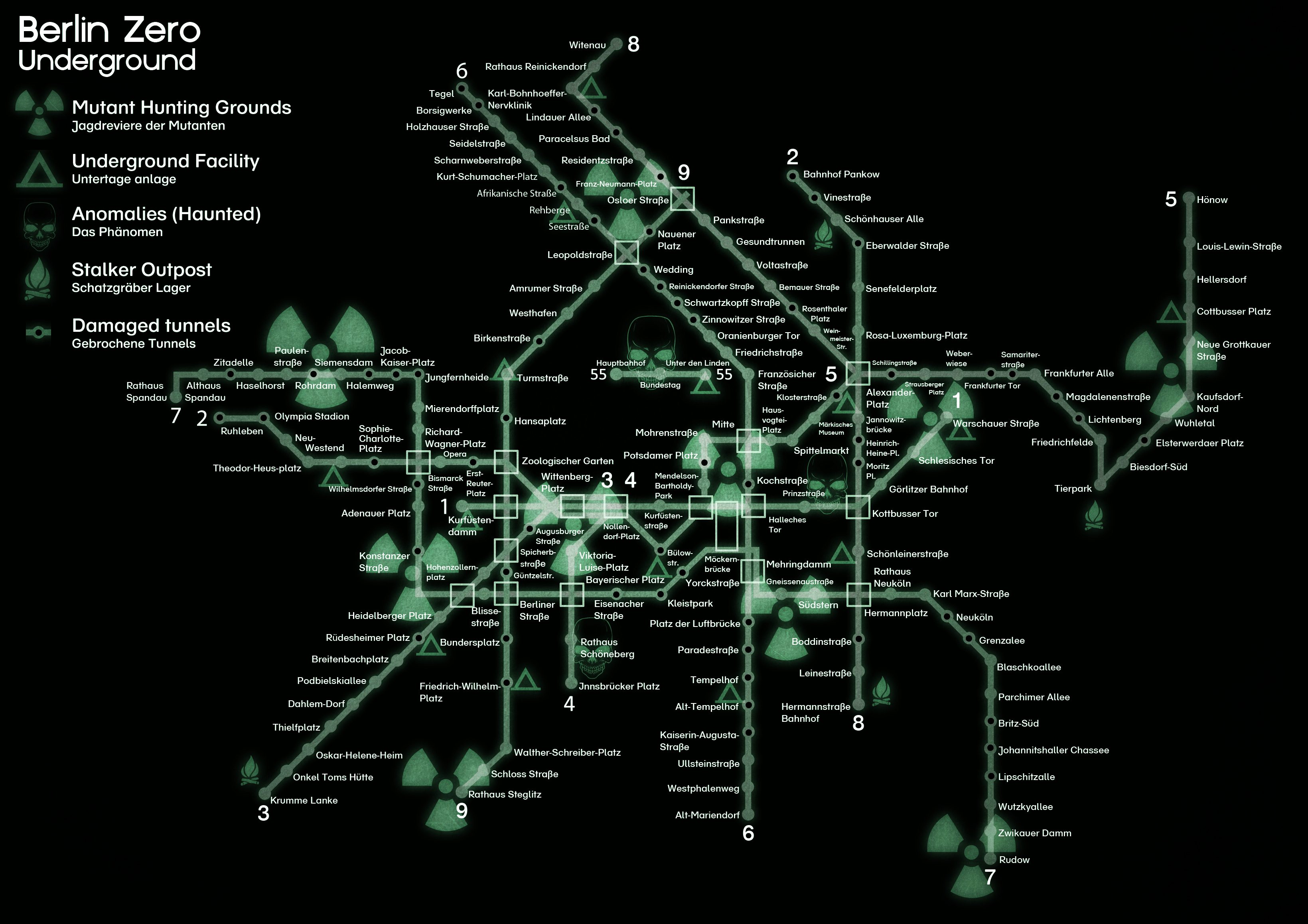
In other news, there is a new map image available for Berlin Zero Underground. All hail #praedor fans with free time on their hands (and who are willing to show me "how it is done". I sit corrected). Did you know that Toulouse has a subway as well? Developing the Berlin Zero Underground has given me ideas for an urban-exploration themed Stalker campaign. More about that later on. I hope to revive my two Stalker groups and will probably offer the urban exploration theme for the first group. I have trouble recollecting what they were expected to do when we stopped playing for unspecified reasons. Stalker Japan could continue as before. I remember exactly what were doing.
Some people have expressed wonderment at my liking of Book of Eli, a post-holocaust film with strong Christian imagery and religious symbolism. I think it was excellently filmed, incredibly atmospheric, loaded with good ideas and while I am atheist, I am a firm believer in the power of religions. The idea of wasteland warlords wanting a religious monopoly with pre-war holy books and relics is perfectly realistic to me. Besides, I think the movie dealt with the theme extremely well. The one part of Day After Tomorrow that did not suck was the atheist librarian protecting the Gutenberg Bible when others were burning books for heat. Call it ridiculous attempt to reach across spiritual frontlines but if a generic holocaust did happen, that guy could be me.
Besides Stalker, I could not help but notice that Deathwatch RPG has arrived. I am not going to buy it but if a copy were to appear from somewhere, I would give it a go (hint hint). Rogue Trader dampened my interest in it an overly convoluted system and terrible organization of text. Maybe Deathwatch will provide a more... straightforward approach.
We will not fail. We are the Ultramarines.
16-Aug-2010:
Deus Ex 2: Invisible War
Square Enix is pushing new fancy trailers of the upcoming Deus Ex 3 and thus inspired, I decided to take another look at Deus Ex 2: The Inivisible War. So, off to Steam we go and I've been playing the game for a hours now, currently prowling the alleys of Medina village in Cairo (wtf?). DX2 looks dated but not impossibly so. Reminds me of the Russian scifi adventure games I used to buy from Gamersgate. Reminds me of them quite a lot, actually.
DEX is of course a sequel to the legendary Deus Ex 1 and often derided for being a horrible letdown and a franchise killer. And true enough, there is a of things wrong this game. As a shooter, it is atrocious. And whoever designed the inventory system should be skinned alive. The whole thing screams of poor production quality and rushed finish. But as an adventure game it is okay. There is nothing wrong with the plot and if you are a fan of the old Lucasfilm games, going around talking to people and collecting codes, items and small side tasks feels right at home. So, it is a nifty scifi-adventure game with some misguided shooting sequences.
Shooting is awkward, slow, beset by dead angles and range limitations on weapons which means that a shot that hits dead on from 20 metres does not even ricochet out of anything at 21 metres. Enemies also have this tendency not to keel over and die when hit with a burst of high-explosive fragmentation ammo. The amount of hit points per enemy is insane but the circle strafing battles are impossible because enemy hits and misses are based on dice rolling instead of actually modelling the shots. Well, me being what I am I dug up the *.ini files and increased player-to-NPC damage five-fold. And now it feels normal. I shoot at a guy a few times with a pistol and he dies. He shoots at me a couple of times and I die. That's how it is supposed to go if you can't model an actual run-and-gun battle. What the hell were the designers thinking?
Judging by the inventory system, they weren't.
There are 10 item slots, 5 in the quickbelt and 5 otherwise. You can't drag and drop items into them, so if you want to move an item from slot 5 to slot 1, you have to drop the items in both slots, then pick up the item you want into slot 1 first. You have upgrade options for your weapons which is kind of nice but I've since learned to hate my submachinegun. Finally, the designers' idea of roleplaying is to limit you to 6 cybernetic superpower slots with three options for each. I went for a sneaker-assassin-hacker type of setup but how the powers work is explained very poorly, if at all.
Deus Ex as a franchise deals with global conspiracies in the dark future and DX 2 is not an exception. My character is supposedly travelling around the world, balancing between two factions (and I hate both) as she selects the mission objectives she wants to complete. This is what we did already in Deus Ex 1, as I am sure everybody remembers. However, Deus Ex 1 really feels like a global conspiracy of epic proportions. Deus Ex 2 feels about as epic as eating pizza in my living room and it kind of deflates the whole conspiracy aspect. This is largely due to bad level design.
DX2 came out also on consoles but I have seen what the original Xbox could do with Oddworld: Stranger and there is simply no excuse for mucking up the levels this bad. Basically, the game starts with a cutscene of a nanoterrorist attack destroying Chicago and how cool (if also stupid) you cyborgs are. After that you are placed into a room and lo and behold! The entire game occurs in rooms or corridors connecting them! First I am supposed to be Seattle but it is a maze of rooms and corridors in what feels to be effectively a single building. Then I fly to a ballistic research lab somewhere in the wilderness and the most outdoor they have to offer is a very tightly fenced-in roof. Then I am suddenly going to Cairo and find myself inside an arkology, i.e. rooms connected with corridors. Then I leave the arkology to go outside to the village of Medina (wtf?) and it is a set of corridors and rooms with sometimes the night sky as a ceiling. Usually there is no one about, not even in the busiest Seattle. And if there is, they must all be members of the Westboro Baptist Church because they all look alike.
Maybe designers thought the insane combat balancing was alright because all combat occurs at a point blank range. So far I've had one occasion to use my sniper rifle because my submachinegun could not hit a target from 30 metres.
I can't understand how Warren Spector could have missed the concept of "epic" so bad. If you look at DX1, it starts from Liberty Island, with the fucking decapitated Statue of Liberty standing in the middle. That is an instantly recognizable and a highly symbolic place, even with all the limitations of the engine. Then you find yourself in the slums of the Battery Park. It is gently snowing, there are bums around and the whole city of New York is your horizon. Then off to New York we go and you wouldn't believe how nice it is to have buildings and streets instead of a single huge dungeon.
Yes, this is a decent B-rated adventure game set in a dark future. It is fun and I recommended for old-school scifi adventure game fans everywhere. But if I didn't know better, I would have assumed DX2 was made by some Siberian pirate outift without a proper license and trying to cash in on the Deus Ex fandom (this would also explain why the looks and atmosphere of all the locations was so off). The fact that this is the real deal, the actual game Warren Spector *intended* to succeed Deus Ex 1... it beggars belief.
13-Aug-2010:
BZ: Stalker Underworld
I am on a roll. Here is a (huge) map of the Berlin underground in Berlin Zero. The map is so large because I could not find a high-resolution base to make it from and I wanted to keep the names readable.
Berlin Zero: Stalker Underworld
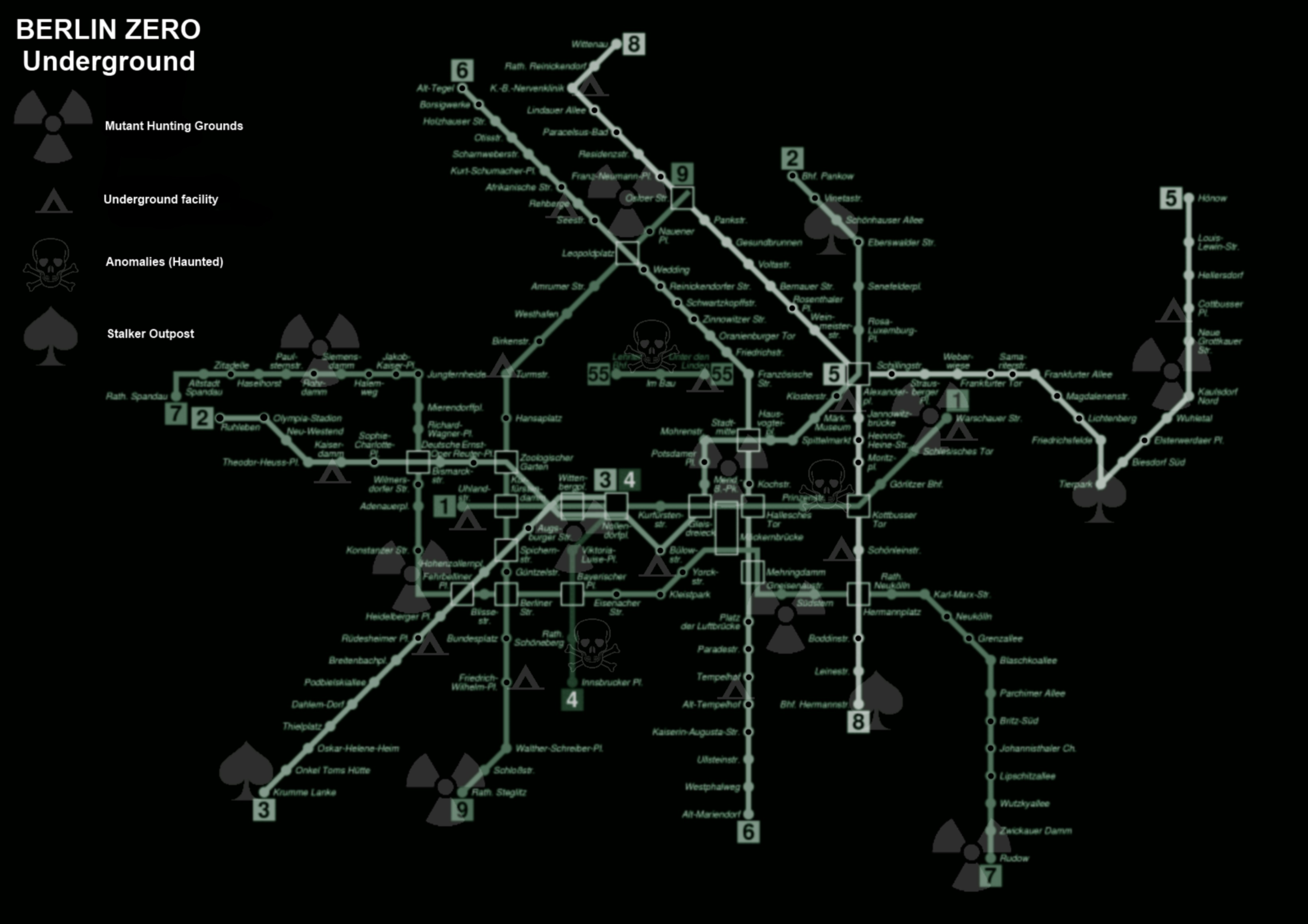
The ends of the lines are on the outskirts of the city, reachable by foot on the surface. Those entrances not overrun by mutants and turned into Radnests usually have Stalker Outposts. It is nothing to boast about, 20-100 people, some basic goods and lively trade of recent loot that relies heavily on personal relations. From the outposts, you can usually traverse the tunnels for a few stations inward and you might even find vehicles for it: cross-country motorbikes or railcars with some kind of engine bolted on them. Stations close to the outpost often have small camps as well, basically a fortified shelter for tight spots. Sealed and defended metro cars are a popular option and even if no one is there, stalkers try to keep a small stock of food and medicinal goodies there in case one of them manages crawl back to them after getting in trouble somewhere deeper in the network.
But sooner or later, the road is blocked. Novice stalkers or those unfamiliar with the territory see a ruin, a collapsed station, tunnels clogged with so much debris it would take dynamite to get through them again. These are indicated by dark dots on the station circles. The only obvious way is either back the way you came, or up to the deadly surface. But if you know what you are doing, you also realise that the underworld is like the blood vessels of a body. Subway tunnels are the arteries but there are always ways forward, shortcuts from one line to another, underground backdoors bypassing mutant nests and hazard zones. There are sewers, maintenance tunnels, ventilation shafts, auxiliary passages, emergency exits, secret corridors from the Cold War days or even before. Some passages close because of debris and structural shifts. Others will open when intervening walls are worn down or some monster digs its way through.
Collapsed stations also mark the limits or boundaries of influence. While mutants can be found anywhere, the fiercest predators rarely venture past the blocked stations. And while you have some hope of rescue on the same side of the tunnel as Stalker Outpost, once past a blocked station you are mostly on your own. Other hazards included flooded passages, structural weaknesses, irradiated spots, toxic spills and... trogs.
The Berlin Underground connects to a host of underground facilities, complexes and bunkers of all shapes and sizes. There are probably more of them hidden somewhere in the darkness. Some of them were population shelters used during and right after the Flash. Nobody knows what exactly happened to them but they are now trogs, ghostly white humanoid mutants, with elongated and clawed arms, sharp teeth and various malformities. Most trogs are blind but they have excellent hearing. Many of them have no eyes. They live in primitive tribes hostile to outsiders but many tribes worship the Monks as gods. Monks sometimes use their superior technology to create superior specimens of Trogs with cybernetic implants and weaponry. Intrusive (and very visible) brain surgery by Monks can enable trogs to operate, if not understand, complex machinery. Trogs like to scavenge food and other goods from the ruins and sometimes even from other Trog tribes. However, their preferences are pretty basic, concentrating on food and simple weapons and tools they can understand. They clash with and sometimes hunt other mutants in the underworld and view outsiders, mostly stalkers, as food and source of shiny objects.
Daylight or any light of similar intensity causes Trogs physical pain. Exposure to direct sunlight kills them within hours.
Not every facility has trogs in it. Some have been taken over by mutant predators too fierce for troggs to evict, or turned into Monk Shrines of superior technology, biomechanical machines, mutant guards and ghastly traps. Some are highly contaminated and others are... haunted.
Anomalies, or "haunting" in the wasteland slang is an inexplicable phenomenon usually attributed to the ghosts of the dead. There are corridors that can make anyone entering them crazy, or strange disembodied lights that kill anything they touch. There can even be gravitic or kinetic anomalies, unusually warm spots with pools of lava and so on. Put on your Stalker RPG thinking cap and you know how it works. Haunted places are usually avoided by anyone but some Stalkers prefer them just because the odds of encountering anything else are low. The stalkers who do this and survive are usually somewhat eccentric. Or philosophical.
Stalkers operating close to the outposts collect basic metals or even ceramic tiles. It is strip-salvage rather than scavenging and takes a lot of manpower. Those operating deeper in Berlin move in small groups and either try to reach probably locations of valuable goods on the surface via the underground, or target trog camps and underground facilities for Cold War stockpiles and Monk Loot. The labyrinth of tunnels underneath Berlin connects with almost every block in the city and especially public buildings like hospitals and police stations. While the streets glow with face-melting radiation and there are mutants everywhere, the interiors of the more intact buildings are usually less hazardous. Nevertheless, stalkers tend to avoid spending any more time above the ground than they absolutely have to.
Oh, one final thing. The lighting. Berlin Underground is not all pitch black. There are glowing mosses, algae and mushrooms. Here and there monks or other stalkers have fixed some of the infrastructure and you even get the occasional light burning. In places radiation makes certain compounds glow and mists tend to be very dangerous. And finally much of the Berlin subway system is fairly close to the street level, allowing shafts of light to poke through where the tunnel ceilings have cracked.
Of course, when it is dark, it tends to be pitch black. Stalkers love night vision Goggles because they don't draw the mutants to you like a flashlight would. Flashlights have a limited range of illumination but the light itself is visible for miles.
11-Aug-2010:
Berlin Zero Thread
I put all Berlin Zero content to its thread on the official Atomic Highway forum. There is also the part 2 of the BZ fan fiction in that thread and if I write any more of them that is where they will go. I really screwed up by writing that story and that is why it is no longer here. However, I did not delete it permanently since there is still a chance I could write myself out of this pit. And screw it, I should really be hammering away at Häirikkötehdas.
I just got myself a new display card, Asus 460. Metro 2033 looks really cool now and the game actually runs faster on High graphics than on Normal. Call of Pripyat is also supposed to benefit from the upgrade but frankly, launching the game was depressing. To facilitate the huge landscapes, Call of Pripyat doesn't really do ground textures. So after having just played Shadow of Chernobyl with every graphical knob set to the max, the contrast was almost too much to bear. Frankly, Call of Pripyat looks like shit. It is a great game, there are even greater mods coming for it and 15 minutes in you don't care anymore. But still, objectively, it looks like shit.
Oh, why the hell can't Metro 2033 be an open-world title? And why can't I edit the enemy values. Hit effects on mutants are crap, they have hit points, they move really fast and there is always a lot of them. In combat I mostly blast away at random and every now and then one of the critters keels over. Combat against monsters is not rewarding and that is a big, big problem in a post-apocalyptic shooter. I wonder how it handles on consoles? Lots of aiming aids? Slower-paced monsters?
Anyway... Brink, Rage, Deus Ex 3, Tier One, Fallout: New Vegas, here I come!
04-Aug-2010:
Helsinki Zero?
Yes, it did cross my mind but now, it is not going to happen. Creating Berlin Zero, I started with a vision of the activities and reality level I wanted to achieve: Old-school Fallout (F1 & F2) with grit and autowarfare, in Europe, or "Roadwars Europe" if you will. I briefly considered Moscow as the city but then settled on Berlin; it is in europe, it has history, there are plenty of pictures of bombed-out Berlin and you can't really resist nazis. More importantly, the city was large enough to matter, there was a beatiful spider's web of excellent roads around it and at 10-kilometre bar scale it was packed with small towns. I could just pick and choose where I wanted to have my enclaves and other settlements, while leaving everything else as battlegrounds and ruins to be explored.
Now go open Google Maps, centre it on Helsinki and use the same zoom level.
Looks like crap, doesn't it? The city itself is about one quarter of Berlin and when you remove the county lines you can see it is sort of spread out along the coastline. The road network simply isn't there and it has like one-tenth of the placenames compared to the Berlin Map. Even if you get out of the built-up areas, you are in suburbs. Frankly, the Helsinki capital area has frankly shitloads of suburbs and many of the smaller towns are basically shopping malls for the surburbs around. It is much easier to built fortified towns in the medieval burgs than a suburban checkerboard from the 70'ies. The Zero concept just isn't happening. The power level of Helsinki Wasteland is just not enough.
Of course, this does not mean that Helsinki would not exist in the Berlin Zero universe. It is there, it was Flashed in the War and it is hairy. Just bring the zoom level closer, to about 2 kilometre bar. One fifth of the Berlin Map. Already, Helsinki Capital Area is starting to look much, much better.
Boom!
The Flash happens high above Pasila trainyard and the heat pulse descends on the ugly-ass office blocks like a giant foot. It compresses but does not exactly level them. Heat pulse sets everything exposed and flammable on fire between Espoonlahti and Sipoo. Anyone caught outside gets the shadow-on-the-wall or scorched bones treatment. Those caught in the immediate fallout get the radiation-sickness-with-a-decent-probability-for-mutations programme and a most of the early survivors painfully degenerate and transform into monstrosities. Through luck and occasional immunity, some 20% of the survivors don't change species. About half of them die from long-term fallout (your standard radiation poisoning) and the nuclear winter that followed. Thousands of them flee north, to relatives and summer cottages with misplaced faith on their outdoor skills.
Twenty years later, the capital area is a swampy wasteland. Gloomy clouds drag curtains of rain across a devastated landscape and rainwater is opaque with dust, soot and radioactive particles. Keeping the rainwater out of food and drinking water is a daily struggle for the survivors. Oh yes, there are some. Family communities, gangs. No larger than steads and holed in defensible positions above and underground. Outside the barricades they can hear mutants moving about at night, mostly bestial but sometimes human. During the day, raiding and looting parties set out for prospects but when the night falls, they either find their way back to trust to find a defensible hideout, for night in Helsinki Zero is murder.
The road network is destroyed, collapsed and blocked by debris. An off-road motorcycle is the heaviest vehicle around. Other than that, transportation relies on backpacks and healthy feet. There is no industry, apart from what can be handcrafted and in twenty years and using modern tools the survivors are getting pretty good at that. Still, competition over resources can and often does result in hostility. And if this was an Italian B-movie, the gangs would be fighting over women as well. However, we are in the Nordics and desperately equal, even if there are some who believe women should focus on having children if they can. In an environment this hostile fertility is not given. Nor is it a laughing matter for any community that wants continuity.
There are no barterowns but there are fixers. All you need to become one is a stockpile of goods, a defensible position, hired guns to keep it yours and phenomenal skill at barterin and evaluating things. By now they are like Mafia dons, whose modus operandi varies case by case from honest trades to extortion. Some may hope to build an empire of dependents but the realisation of such dreams remains far off when you are in danger of being wiped out by a single mutant attack.
There are two types of raiders. Inland, raiders are typically gangs that have gone off the bend, often lead by some charismatic murderer or an apocalyptic cult leader. At sea, there are pirates moving with methanol-driven powerboats looking for loot and slaves. These are taken south and may end up, among other things, to work the coalmines of the Reich. Cult raiders can trade with fixers. Pirates are everybody's enemy.
Both of these threats pale in comparison to the mutant menace. Finland is a wasteland of mutant wilderness. Not only is the mutant population of the capital area sizable, more venture in from the northern woods all the time. Whilst the beast can be deadly, the true competition to humans comes from mutant tribes. Many of them were once survivors or even witnesses to the Flash. They are gibbering madmen twisted in both body and soul but still possessing enough cunning to wield tools and weapons. There are different levels of mutants based on their reasoning. The very top are almost human and can wield firearms but the most are restricted to cruel melee weapons or are little more than trained apes. There are rumours of mutant shamans who can command mutant monsters and perform great feats with their highly toxic brews. Whatever the truth, there seems to be some kind of non-hostility pact between humanoid and non-humanoid mutants.
Hmm. Needs work but you get the picture. Berlin Zero has pockets of mutant menace guarding science fiction treasures. Helsinki Zero has pockets of humans clinging on to remnants of technology while mutant monsters and medieval warriors conspire to wipe them out once and for all. Hmm. The human societal structure is very simple compared to Berlin Zero. Maybe I have to find a way to introduce stragglers or something into this concept. Or make Helsinki a straggler capital, where the original survivors are degenerate trogdolytes striking out from the man-made caves underneath the city centre and there are enclaves far out in the countryside, coming to the city to trade with the pirates...
Hmmyeah, this definitely needs work.
02-Aug-2010:
Bad Form
Sometimes I get carried away.
30-Jul-2010:
Berlin Zero
I got a bit carried away planning my Atomic Highway adventure this week and made an "Official Intro Site" for it. It is really just the bare bones of the setting but at least you can see what I will be building on. Following the Old Skool tradition, I will make up more stuff as I go and if I am not feeling lazy, some of that might appear here as well. Perhaps as adventure seeds.
Just remember that this is not an advert to any publication of mine (Atomic Highway was actually written by Colin Chapman) and that I hereby declare Berlin Zero public domain (it is fundamentally system-independent). To me, BZ is a tribute to Colin and something fun I planned to do with my friends this weekend. If anyone else finds it useful or inspiring, great! Go get them!
To The Official Berlin Zero Intro Website
26-Jul-2010:
I Am Going To Nuke Berlin
Oh damn it. I had plans! I had things figured out! I would write a mini-rpg and run a cyberpunk adventure in Terminal Complex for the folks back home (one of our friends moved in so I guess this makes Myyrmäki HQ officially a commune). I have been thinking about HAX day in and day out, so surely a roleplaying adventure in it would be a walk in the park?
Unfortunately, Ropecon threw a major wrench into the works and here I am, writhing in agony over a "wrong" inspiration. It is that fucking Atomic Highway I picked up from the Fantasiapelit booth. I am a long-time post-holocaust fan and never pretended to be anything else. Somehow that game, all 130 pages of it, punched me below the belt. I have bought post-holocaust RPGs before and never paid any attention to them after the first read-through but something is different with this one.
Maybe the obvious eagerness of the writer is contagious? Or the nifty dice pool mechanism (V6 engine) calls to me as I actually have limited experience of playing with dice pools. Colin Chapman was even sweet enough to include the probability tables at the end of the book. It is a small and easily missed contribution that actually helps quite a bit if you plan to bring in house rules or additional mechanisms.
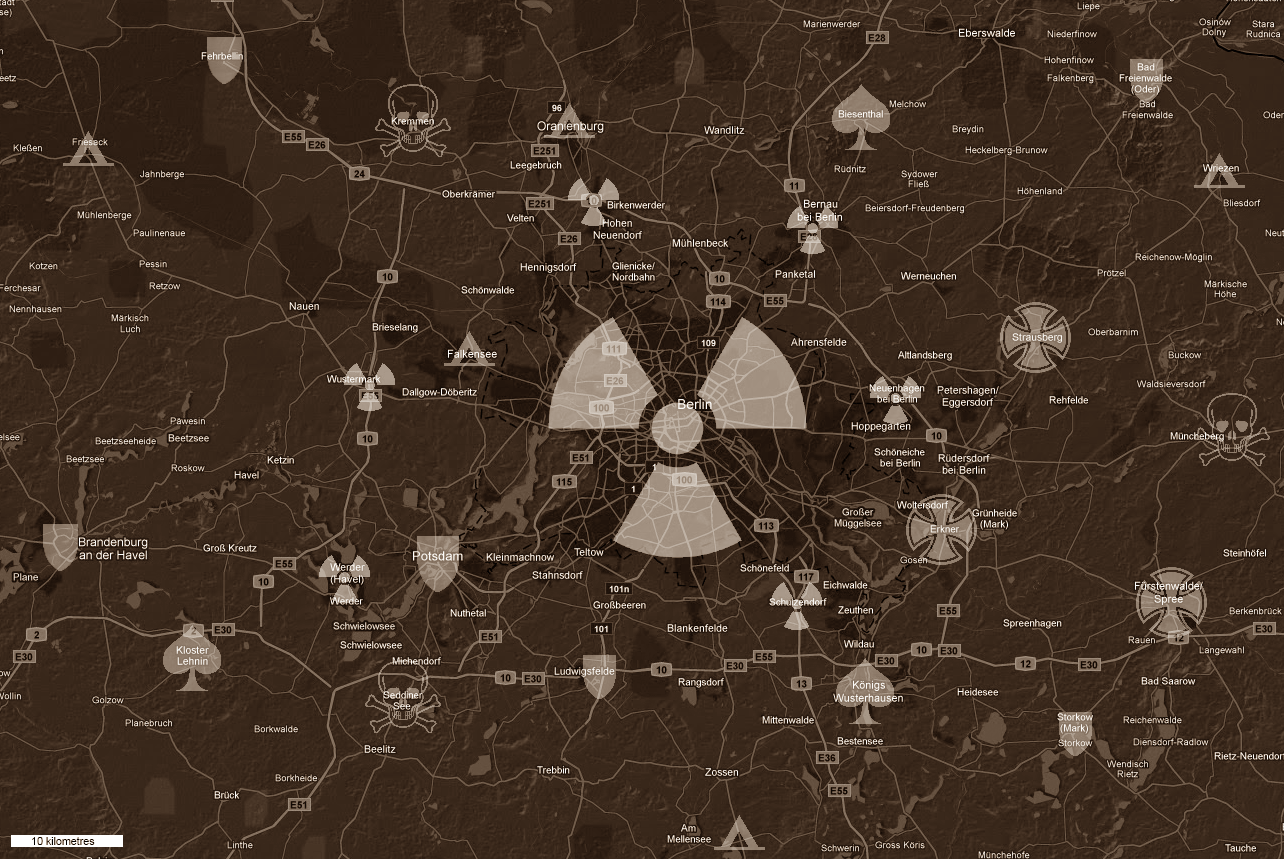
Atomic Highway is a roleplaying game of roadwarriors, cars with guns bolted onto them and drooling mutant cannibals crawling out of sewers that spew green mist. It is like Fallout 3 meets Car Wars and the author is laughing at the face of realism (although the Fallout supertech is nowhere to be found). The setting says something vague about a nuclear holocaust in North America but there is no map and the whole thing feels like it was awkward to write. I have absolutely zero interest in post-holocaust US of A so I need an alternative setting. I tried to find a useful and sufficiently gamey map of post-holocaust Europe. You know, major roads, some terrain features, dots for post-nuclear townships and big radiation signs for where the bombs fell and everybody died or turned mutant.
Unfortunately I couldn't find any and since I can't draw even a straight line, I have to do something else. Some post-holocaust RPGs focus on a fairly small area, like "post-nuclear california" or "Death Valley Free Prison". Since I couldn't go big I am going to pick a special area of my own, something complete with roads, townships, rural patches turned wastelands and a big metropolis I irradiate the shit out of.
I am going to nuke Berlin.
BOOM!
There! A giant radiation hazard sign in the middle, crawling with mutants and glowing in the dark on calm nights. The action is all around it but foolhardy scavengers known as "stalkers" also venture into Berlin using the pre-war subway system. Outside the city remnants of civilization, anti-tech tribes and a free-roaming Guild of Traders are struggling to survive, fighting against gangs, mutants and each other over limited resources. Slavers from the east sometimes raid the settlements, while ragged bands of refugees trickle in from the south, lured by the promise of something better up north (and passing into Neuhanse once they get through my map).
Since we are in post-nuclear Germany, we must have Nazis (thanks, Iron Sky!). A militant enclave of neo-nazis from the Fourth Reich, with distinct uniforms, is slowly but surely conquering the map, oppressing and enslaving the living crap out of everyone not up to their übermensch standards. With mutants around, also as characters, there are plenty of people to be "putsched". And now that we are at it, how about some mysterious high-tech band of monks or priests in the centre of Berlin, using super-science and psychic powers to organize the mutants into army and getting ready to sweep away the remnants of Old World once and for all!
Let's top it off with ice-cool roadwarriors (the bastard offspring of Mad Max and Han Solo) roaming the autobahns in their souped-up killing machines and taking out bandits, nazis, muties and each other. Yeah... I can already see one of them checking out the wanted posters on the billboard of some bartertown. Sure, he could drive right out of my map in a few hours but there is nothing out there. Just other spots specced out by other Atomic Highway and Neuhanse players and their gamemasters aren't here.
Trust me, Berlin Zero is where the action is. At least for those living in Myyrmäki HQ.
24-Jul-2010:
Ropecon, Friday
I removed the HAX redirect because this stuff will be exclusively about pen & paper and there is plenty more to come.
So, Ropecon, on Friday and finally, finally, the first solid release of Neuhanse by Mert Sasioglu and some other people who are even worse at branding themselves than he is. The game is a freely downloadable PDF and very much a work-in-progress (they've actually labelled this version Beta 1.0). Fortunately they did have some paper copies with them and thought I was sufficiently awesome to receive one of those. I've been reading it through again and again, so here is my take on Neuhanse Beta 1.0.
It is short, it is clearly incomplete (the whole thing is set around Baltic and yet the sea does not really feature in the setting description) and you can tell the writers haven't had much experience. It also lacks a focus, offering only a selection of suggested campaign types rather than a solid core from which to expand into other modes. But with all that said, I like what I see and could imagine gamemastering this game or setting. I especially like the rules which capture the intent of Code/X really well. I am afraid they will be ruined, though. The authors did not think them as very important and the audience was bombarding them with complexity-adding suggestions ranging from combat action cards to resource pools.
What would I do? I would change the range of attribute values to 0..+2 and the skill value range to +1...+3. For the most part these changes would cancel each other out but players typically prefer a wider skill value range. Then I would make it clear that a number of things simply cannot be attempted (at least in any way effectively) without at least +1 in the proper skill. Finally, I would add the attack's margin of success to any damage roll but the shock test would only be made when hit and not in the beginning of every successive round. As written, the rules would make your average barroom brawl look really, really odd. But that's just me and if Mert and the boys are really contemplating removing or isolating the system from the setting all this is academic. I would not do it but it is not my game.
So, I would make some changes. And perhaps I will. I have been looking for a quick and dirty dice system for my upcoming Terminal Complex Roleplaying Game (a personal product for an RPG campaign I want to run). This could be it, with the right mods. There is already enough resemblance to Stalker/FLOW so conversion should be easy.
But honestly, when presenting a game project at Ropecon it is not enough to have the game. You must also have the balls (or ovaries) to stand behind your creation, demo it to the public and generally make noise about it. Don't tell us that you haven't really tested any of this stuff. And... for all the gods' sake, if someone had told me what happened I would not have believed him. Unfortunately, I was right there. The authors told the audience that they are not running the game at Ropecon because they feel neither the game nor they themselves are up for it.
If this is the case what the fuck are you doing on stage at Ropecon, Mert? Why the fuck are we even listening to you? I honestly liked Neuhanse but as release presentations go this was a fuck-up! Ilmari Virtanen (THOGS) would wipe the floor with you lot and his game is a joke compared to yours!
*sigh*
Neuhanse Beta 1.0 is here. Download it, read it, run it and let the guys know what you think. I think it is a very good base of a game and the guys deserve a pat on the back. However, what they need is a kick in the ass.
My other purchase, one that I had discussed with the author already at Finncon, was Lamentations of the Flame Princess by James Raggi. The small box kicks ass, being small, sturdy and pretty to look at. Unfortunately the aesthetics do not extend to the contents. Besides that this is, well, Dungeons&Dragons right down to the rules. Raggi is one of the leading authors in Old School Renaissance (which has nothing to do with the Old Skool I am part of) and the justification for releasing this unabashed copy of old D&D is that if a player wants to start roleplaying with same kind of games that Raggi himself started, LOTFP fits the bill. I don't know any reason besides nostalgia why anybody would want to start with D&D as opposed to Runequest, Cyberpunk 2020, Stormbringer or Praedor. Then again, I am about as far removed from the target audience as you can possiblyget. I am sure the game itself works just fine.
Atomic Highway is a post-holocaust game in the traditional Car Wars style and honestly, this is baby is done right. This is post-apocalyptic vehicle combat porn and I love it! I don't know if I could build an entire campaign around the concept but Colin Chapman apparently thinks so and I swear I smell gasoline every time I open the book. I have always missed the balls-to-wall attitude of Games Workshop's long-gone miniatures car game Dark Future. This has it, or at least can be converted into something approaching that level of bold badassitude. On the other hand, if the Roadwarrior truck chase turns you on, you will be reading this rulebook with one hand only.
Finally, I bought the hardcover version of Eclipse Phase. I already had the pdf from one of the webstore bundles but as we all know, nobody takes a full-length PDF game seriously. The rulebook looks gorgeous and the game is transhumanist science fiction set in our Solar System. Transhuman Space comes to mind except that the EP layout is not crap and the system is something I could seriously consider playing myself. The game makes a clear distinction between the character's ego (consciousness or persona) and morph (physical or digital body), presumably allowing the player switch from one morph to another as needed. I don't know for sure as I haven't really read the 300+ page monster yet.
I concluded my Friday with Mikki Rautalahti's presentation on Alan Wake (he is the second writer). It was a good one, although much of the stuff was familiar to me either through similar work or from earlier Alan Wake presentations by various people from Remedy. Still, Mikki's anecdotes were pure gold and his comparative analysis of videogames and roleplaying games was quite interesting. Like the rest of the world, I am angry at Remedy for abandoning the PC as a development platform even if I am more aware of the economic realities behind it than most. Still, I think Alan Wake is an impressive piece of work by an equally impressive bunch of people.
06-Jul-2010:
Writing Break
I am leaving for a 10-day retreat in the Northern Wilderness tomorrow and taking my laptop with me. I need to finish Häirikkötehdas once and for all and this might be a good opportunity to do it. After that it is back to fiction, which unfortunately also means writing non-commissioned works. My pseudo-factbooks have been a "sure thing" as authoring goes. They were commissioned by their respective publishers. I've never written something completely on my own.
Another big elephant in the room is what I should do with this website and blog. Obviously haxgame.com and its dev blog is going to take most of my blogging time and energy from now on and Burger Games as such is not going to do anything drastic while the HAX development continues. And if all goes well, HAX development never really ends. It will just lead on to expansions, supplemental material and other bigger and better things.
And all the while, nothing much is happening here and apart from Neuhansa (whose author contacted me and told him he had requested the smaller presentation room at Ropecon thus arousing serious doubts about his sanity) nothing that interesting is happening the RPG scene either. Apart from the impending English translation of Stalker RPG, that is.
I don't know if I am really going to pull the plug on this thing and having Burger Games around is occasionally useful for billing projects. But don't be surprised if the Designer's Notebook goes on something of a hiatus. Check out the dev blog at www.haxgame.com instead.
05-Jul-2010: WWW.HAXGAME.COM
...and we are out of the closet! The website URL is in the header and the facebook group is HAX if you search for it. The game itself will be out before the end of this year (if I could put an exact date on it I would make a press release instead of a blog entry). The website tells all the basics and we will be adding a forum shortly. The Facebook group is there because things like these are supposed to have Facebook groups.

There. The picture will act as a link. I will be adding more stuff to the Facebook gallery over the next couple of days and then flee to the Arctic Circle. And as soon as the Tracon presentation is available somewhere, it gets added to the Media section of the website. I just wish I had given the presentation in English. HAX has its own dev blog that competes with this one for my time and effort. Right now the dev blog is winning because while HAX is in development, Burger Games exclusives will be on the back burner.
 26-Jun-2010:
What? Again?
26-Jun-2010:
What? Again?
God damn it, Ropecon programme team! I tore you a new one for this already in 2008 but I guess that wasn't enough. While the Ropecon programme chart isn't officially out yet, the The Burger Games Intelligence Service (BGIS) has found out that the launch presentation of Neuhanse will be in the fucking Klondyke Room instead of the Auditorium. Even better, there is nothing else marked down for Auditorium while this is happening. This is moronic! I haven't forgiven you for putting the Stalker Launch presentation in Ropecon 2008 into Room 25 with the result that not everyone could fit in. Meanwhile the Society of Nordic Roleplaying did its best to entertain a two-thirds-empty auditorium. Being a launch platform for new Finnish RPG titles is perhaps the most important function Ropecon has but you suck at it!
Now, if I had booked my HAX presentation for Ropecon instead of Tracon, Klondyke would be the perfect place for that. As it stands, my HAX presentation will be at an indeterminate moment in Keltsu to an audience averaging about four. Mikko Rautalahti is going to speak at story writing for Alan Wake at Ropecon, though. I might be watching. I have also been asked for an open session of Stalker at some point. That too will be happening in Keltsu, if it happens at all.
Other than the preliminary reports indicate that most or almost all of the stuff I am interested in at Ropecon will happen on Friday. That's a bit of a bummer.
25-Jun-2010:
It Is Finished...
...unfortunately I was only referring to my Tracon 2010 presentation materials. There is a ton of important unfinished stuff lying about in my mental space, from cleaning up my studio at home to finishing that god-damn book Häirikkötehdas.
I should really fix my bad habit of starting a book with the foreword as they rarely end up being exactly what I first envisioned. In this case my early plans were actually guesses more than actual plans of anything. Häirikkötehdas is turning out to be some kind of weird geek biography with a strong but not exclusive focus on experiences with and in educational facilities. That still makes more sense than the publisher's early definition for it but I swear, honest to the Great Hippopotamus, that this is absolutely the last autobiography I will ever write. I am hoping to make it fun, easy and opinionated as my "factbooks" tend to be. If you liked Elämäpeli, odds are that you'll like Häirikkötehdas as well but I am glad I am not the one who has to figure out to whom this thing is to be marketed and how.
I envy Mike Pohjola's relationship with his publisher, Johnny Kniga. I don't know what their deal really is but at least he gets to write fiction all the time. I seem to be stuck with pseudofactbooks on game development or general geekery. It could be worse but factbooks are basically about things that have already happened or are otherwise out there for everyone to see and experience. Fiction, whether it is literature, roleplaying games or video games, lets you experience something entirely new and unattainable. It is also its weakness. In one of the game studios I have worked in the past I was told by more than one people that they hated fiction (and one of them reserved a special hatred for science fiction) because "it is all just lies told by some dude for money". I have hard time reconciling that attitude with working in the creative industries as a developer. Then again, I like my job. Maybe they hated theirs but stayed on because... big bucks? Stress-free environment? Steady employment and financially stable employers?
Mind boggles.
P.S.
Yes, the HAX lead artist has also done work for Stalker RPG in the early years. After all, the game was years in the making, remember.
22-Jun-2010:
Yes, It's Been A While
But I didn't want to write more until I had something new to show you.

This is a small part of the world intro that will be on the HAX website. It is also a good example of the webcomic-style narrative used to carry the plot and storyline missions forward. We are making progress and while the lead programmer busted his arm and has been climbing on walls with frustration, the techside team has actually cleared a couple of major hurdles (from my perspective as a designer I would consider them The Greatest Hurdles) we've had with the code: the detection and stealth. If they were not working, nothing else would have mattered. By the way, if you are getting bored with the HAX and tech talk, you are in luck: in about two weeks we will open the official HAX website and my dev blog technobabble will move there. I'll give you the URL when the time comes.
In other news, whenever you hear really bad mixing and sound quality and rock festivals, blame Ari. This is not anyone I know but during the Suburban Tribe soundcheck I learned that there was someone called Ari in the mixer tent of Myötätuulirock. And oh boy, did Ari fuck things up! It is true that you don't really get a CD-quality experience on most rock festivals but there are limits as to how low-fi you can go! On Friday, Tarot was completely drowned out by their Bass Guitar which sounded like someone playing Vuvuzela in super slow-motion. Marco did open his mouth but whether he was singing or gasping for breath I really can't tell. Los Bastardos Finlandeses were drowned out by its lead guitar distortion. If I wasn't a fan and didn't have all the albums it would have been impossible to tell what song was what. Suburban Tribe, which I don't know, was either an atonal orchestral or also mixed to hell and back.
Fortunately, some things worked. Kiuas sounded okay and Mustasch, wow! I didn't know either of these bands but Mustasch rocked my socks off and not least because the mixing had gone accidentally right and I am all the more bitter for it now since I know what the sound quality could have been like. Amorphis closed off the festival but I think Mustasch had most to give. As much as I like Skyforger (by Amorphis), it is not something you should hear in an outdoor festival. Book the Finlandia House or the Helsinki Opera and play it there instead as a concert, without the disruptions and idiots.
Low attendance by the way. I wonder how Myötätuulirock is doing financially?
P.S.
Although North Korean got crushed playing against Portugal, I still respect them more than the French team.
05-Jun-2010:
Plague and CyberFlow
My girlfriend and I fell ill with stomach troubles at about the same time. Half a week has passed and while she is recovering well, I'm going downhill. I still have vivid memories from the campylo-infection I had two years ago that ended up costing me most of my summer vacation. If I am not getting better tomorrow, off to the doctor we go (probably for some antibiotics once they figure out what bacteria it is). With my interesting history of exotic diseases, my personal guesses range from Plague to Typhus. As outer space begins at 10 metres from the closest lavatory, I've been working from home, writing HAX in the evenings. Progress is slow but I want my storyline missions to be interesting, if simple to execute. They often involve world exposition and if put together, would make a fairly good cyberpunk comic book.
Meanwhile, Sami Koponen wrote a piece on his attempts to bend FLOW into other genres. I would love to recommend this article but to me it seems like he is actually struggling with some fundamental flaws of, well, thinking.
FLOW is built around a challenge system. By definition, it is meant to resolve challenges, i.e. player actions with a set goal but involving significant risk of failure or incomplete results. Choosing whether to climb up a wall or take the stairs is not a challenge; it is a decision and does not involve game mechanics. But once that decision is made and the player wants his character to climb up the wall, the action of climbing the wall is a challenge. Maybe it is part of Forge philosophy or something to involve the rules in absolutely everything but FLOW is an Old Skool system. It treats the game mechanics as a toolbox where the gamemaster can take out a tool when he wants to and put it back when it is no longer needed. Between the obvious challenges or when the player deliberately wants to use a game mechanic to influence something, the system "does not exist". As a result, the system does not exist in roughly 95% of the time.
That said, I've had my own troubles in converting it into other genres. My babblings about HAX have lead to a small resurgence of interest on CyberFlow. I am my own worst enemy as far as that project is concerned. Cyberpunk roleplaying has been sold to Finnish gamers in a specific, micromanagement-centric way and I am not an exception. CP2020, Shadowrun, various smaller games in between; they are all based on micromanagement of resources, be they implants, weapons, body armour, drugs, spells etc. That does not fly with FLOW. Here my attempts to produce a diceless Old Skool system for ordinary gamers falls apart.
While FLOW most likely does a better job at emulating literary and movie-based cyberpunk settings than either vanilla SR or CP do, it cannot emulate the kind of playstyle offered by those games and what has become the genre standard for roleplayers. Even if you didn't change anything in the setting, forcing FLOW on Night City would necessitate a major rethink of the gameplay methodology. I am of course supposed to be in favor of this but frankly, it may not be what modern gamers would be looking for in a cyberpunk roleplaying game. So I am back at re-branding my strain of cyberpunk into street scifi.
My design process is setting-centric. I don't like doing generic stuff and usually fail when I try. In short, no setting inspiration means no game. CyberFlow is based on "Terminal", the wider setting for HAX. Hax is but one of the many street cultures in Terminal Complex (I would love to say "shadow cultures" but I don't want to step on Shadowrun's turf). These are not character classes but cultures, with their own ideological constructs, power hierarchies etc. Maybe I should call them Street Nations? Some of them coexist with or even form part of the mainstream, much like big religions and moderate ethnic identities do today. This does not mean the co-existence would be problem-free. With the advent of trans- and post-humanist street cultures there is more than enough opportunities for racist or even speciest undertones and ideologies. But by and large, they are all part of the larger society.
Others like Zyncs or Mekas are peaceful even if they are incompatible with the rest of the society. They can still form their own communities or even microstates in the patchwork of Street Sectors, limiting interchange with other cultures to levels they are comfortable with. Then Hax and the like exist in the grey area. Not all Hax are criminals and the subculture has adherents in related industries and media. But the more extreme end, the one featured in HAX is criminal and parasitic. The mainstream would wipe them out if they could.
Completely hostile cultures are usually short-lived, highly secret and from the mainstream's point of view, slightly insane. This includes death cults (think Thugees in the 19th century India) or political groups so opposed to the dominant cultures that they are at war with it. Think Al-Qaeda and the modern West. These cultures can coexist with more dominant cultures as secret organizations or sleeper cells. And they are not exclusive to Street Sectors.
Much of the higher politics of the Cartel is driven by the competition of secret organizations within the Cartel Elite. And while the Singularity Cloud is poorly understood, it does have its equivalent ideological clusters and competing trends, much like a human being can have conflicting goals and personality traits. Their goals can be very much at odds with the interests of the mainstream, at least in the short term. This is all great for someone writing a book, or making a computer game where complex interactions with other players are recommended but not enforced.
Traditionally, the literary genre of cyberpunk is all about lone wolves or at most small groups of lone wolves temporarily united by some shared interest, even if their goals remain different. Loneliness in the dark future society is part of the future shock cliche. Humans are herd animals and ties to social groups and hierarchies are part of our fundamental needs. Even in the novels, these lone-wolf protagonists stand apart from the mainstream cultures surrounding them. That makes them exceptional but also leaves them struggling to cope with whatever adversities they are facing. This is easy to replicate a video game but a roleplaying game is a social event and for Old Skool gamers like myself, interactions and social developments within the group over a longer period of time form a big part of the fun in campaign play. This forms a dilemma that CP2020 could never really resolve.
Shadowrun could. In retrospect, I am wondering if that contributed to its success more than the rather superficial fantasy elements usually cited as a reason. Characters had their own racial and professional backgrounds or scenes. "Shadowrunners" (runner being a commonly used term for any kind of dark future adventurer in this genre) were a subculture within the higher level cultures. Characters would come from their home cultures, join together for a shadowrun op, reap the rewards and return to their respective cultures. In some cases their social circles within the home cultures would have been unaware that the character was a shadowrunner.
My games are known for adventurer cultures that exist and sometimes even compete with the mainstream. But they are still static structures: very few praedors or stalkers have a meaningful social existence outside their identities as adventurers. This way, becoming an adventurer involves a heavy sacrifice. It is a rite of passage, taking the character from the world of familiar comforts and responsibilities into something new, dangerous and unknown. It also reduces the significance of those mainstream cultures in the setting as a whole. Shadowrunning, as portrayed in the previous paragraph, does not. Maybe instead of looking at old cyberpunk roleplaying games for an adventurer model I should look into espionage and conspiracy games like CORPS?
The characters would have real lives as part of their respective social backgrounds and street cultures. Running, shadows or not, would be an activity or a part-time subculture at most. You could even play a Hax in a group if you wanted. The ghost runner activities, the stuff featured in HAX the Game, would be part of the background this particular character is coming from. It would give him resources to use when adventuring as part of the group and once the adventure is over, he would return to his netrocentric culture and acquire more resources for the next adventure. But his ghost running would not be part of the session gameplay and therefore the traditional netrunner problems would not exist.
P.S.
Have you all downloaded Machete Girl #1?
And check out Deus Ex 3!
01-Jun-2010:
Summertime
Have you all already downloaded the Machete Girl e-zine? Because if you haven't but you are still reading this, you are out of excuses. Now Get!
Nuurori asked at majatalo.org (before it went down) why won't people like me publish their stuff for free in PDF format. Simple: if a product has no cost, the general public automatically assumes it does not have any real value. Second, nobody uses pdf rulebooks for real. I myself bought a shitload of stuff from DriveThroughRPG when they had their big sell-off and haven't read any of it, nor has anyone else I know who did the same. A magazine, especially if it is well-written and edited with suitably small chunks of text, now that I might read just like I might read a webcomic. Some say Machete Girl is still looking for its editing style but hell, *I* am not complaining.
So, it is Summer. And I started it by falling over in the shower and busting my leg. My leg feels numb, the rest of my body is tensing up and my head feels stupid. On the plus side, I have now scripted and specced 9 of the 16 storyline missions for HAX. On the roleplaying front absolutely nothing is happening. I am buried in projects, one of my Stalker players is in a hospital (mauled by an anomaly) and Häirikkötehdas could use a new chapter or two. Man, and I thought Elämäpeli was difficult to write.